Friday, October 28, 2011

Peace Memorial on a cliff top


Photos by Raquel C. BagnolSITUATED over 800 feet above sea level is a must-see and must-visit mountaintop on Saipan that has played a very important part in the island’s history.
Standing near the railing at the view deck of Suicide Cliff on a Friday noon was not in my plan but there I was last week, cameras slung around my neck ready to take another batch of photos of the place where thousands of Japanese soldiers and civilians choose to jump to their deaths than to surrender to the American troops during the war.
Turning away from the breathtaking views of the Veterans Cemetery and the blue ocean that stretched for miles and miles away, I walked a few paces to the Peace Memorial, a monument that has claimed visits from thousands of tourists, each year. Most of the visitors are Japanese who come to offer flowers and food to their dead ancestors.
According to the sign at the foot of the monument, the Peace Memorial was constructed to console the spirits of those who died — regardless of their nationality — at this historic area and to remind the people of the tragic futility of war. The memorial is built with hopes that everlasting peace and friendship will prevail among mankind
The construction of the Peace Memorial came through the efforts of the people who lived in the Pacific islands and it was dedicated in 1972 during the Trust Territory government.
During the early months of the year, the Peace Memorial takes on a spectacular view as the flame trees blossom where its flaming red and orange flowers provide a wonderful contrast to the blue skies and lush foliage.
Sadly, burglary incidents have been reported happening in this Peace Memorial site and at Suicide Cliff.
With no security in the area and with overgrown bushes at the side of the Peace Memorial leading to the Banadero Trail,  a thief can get away easily after robbing a tourist.
Stakeholders in the tourism industry said the government should look into clearing these bushes and jungle area so criminals will have nowhere to hide. Visitors feel safe and peaceful. After all, this is a Peace Memorial.
http://mvariety.com/special-features/around-the-island/41239-peace-memorial-on-a-cliff-top.html

Friday, October 21, 2011

Exploring historical pieces at Tinian airport

 STRANDED for over an hour to wait for the next flight in an airport has never been a bother for me, but not when you are not feeling well and the ground seems to shake and your start to see double of everything. Most of all, not if you are stranded at the Tinian Airport where there is nothing to do but stare at the empty seats and the small confines of the departure area.
Fighting the urge to curl up on one of the benches and go to sleep last Monday, I had time on my hands with nothing to do. I left my Kindle at home, which would have come handy that time and it was no use wishing I had called earlier to reconfirm my flight back to Saipan. Otherwise I would have spent another hour in bed in my hotel room.
Walking out of the departure lounge, I stared dully at the deserted roads and the burning heat outside and saw something that I have always seen before but never paid any attention to—relics of the World War 11 located just in front of the airport building.
Fishing out my cameras and my boredom forgotten, I walked over and started taking photos of the Japanese cannon and B29 wheels and an antiaircraft machine gun. These historical pieces were found in a firing position and hidden in one of the caves in San Jose, Tinian and have been moved to the airport to create a historical display.
Innocently sitting there in all its rusted glory is a machine gun with the steel seat still attached was reported to be one of those that inflicted heavy damage on the battleship Colorado and destroyer Norman Scott during the first day of the battle of Tinian.
Beside the machine gun is a plaque erected and dedicated to honor the surviving VPB-116 Blue Raiders airmen who served on Tinian.
Located at the historic west field of the island, Tinian Airport is the third of three runways used by the 58th Bomb Wing of the 20th Air Force and constructed for the B-29 Super-fortress for smaller planes.
That spare hour before my flight gave me a chance to capture on the lens more relics that have played important roles during the World War 2. If you’re on Tinian, take a few minutes to check out these artifacts right outside the airport building. You just don’t know how many thousands of people around the world envy you for having this chance.

Friday, October 14, 2011

Moon shooting at dawn


THE whole neighborhood was already in dreamland past 3 a.m. when I went out of the house to get a whiff of fresh air a couple of days ago. The world was bathed in full moonlight that it was almost daylight. I was unable to resist the urge to go out and try to capture the full round beauty that most of us take for granted. I decided it was time to put one of my dormant investments to work.
Going back in, I unearthed a 1300mm zoom lens that I purchased some months from its box, shaking off the layers of dust that had accumulated from neglect.
Struggling with a heavy duty 6-foot tripod and the heavy lens was a battle. I haven’t found time to experiment with the knobs and bolts and nuts of both tripod and lens yet and it took me a good quarter of an hour before I was finally able to attach the lens to the tripod.
Getting out of the door with the whole thing was a harder battle and I was scared that the moon would have set by the time I finally get out and the sun would be on its way up.
I succeeded after much struggling and positioned the lens toward where the moon was. I saw only total darkness. I twisted and adjusted knobs and the camera settings but still nothing. The lens would not work. There goes hundreds of dollars down the drain, I gave up in frustration.
I was about to pack everything up and start the struggle of getting the whole thing back inside when I found that the lens cover was still in place that’s why everything was black.
Like a child, I peeked into the viewfinder and kept turning the focus until finally I saw my moon, big and full and round with the blotches and craters that I was unable to capture with my standard lens.  Excited, and armed with my Canon SLR, lens and no knowledge of how to take moon photos, I clicked away, experimenting with different camera settings but it was no easy feat. I had to really stretch out my arm to reach the far end of the lens where the focus was.
Tired but satisfied at last, I ended my dawn adventure and downloaded the photos to my computer. I was unable to capture sharp photos but I was happy with a couple of photos I considered ‘passable’ from almost a hundred shots. Talk about the effort and the muscle pains I went through the next couple of days from struggling with the heavy weights.
For centuries, the moon has never failed to captivate people from all over the world. It has always been a fascinating and intriguing subject to shoot.
Yes, you are right. There’s a full moon every month and we see it going through the different phases throughout the month. We enjoy its brilliance and take it for granted but have you ever really taken time to appreciate this beauty of nature?
When you can, try to capture the brilliant moon with your camera. You don’t need to be a pro. Just enjoy what you are doing. Saipan is one of those places that has lots of ideal places to get really good shots of the moon. Happy moon shooting!

Friday, October 7, 2011

Noonday respite at a coral beachside


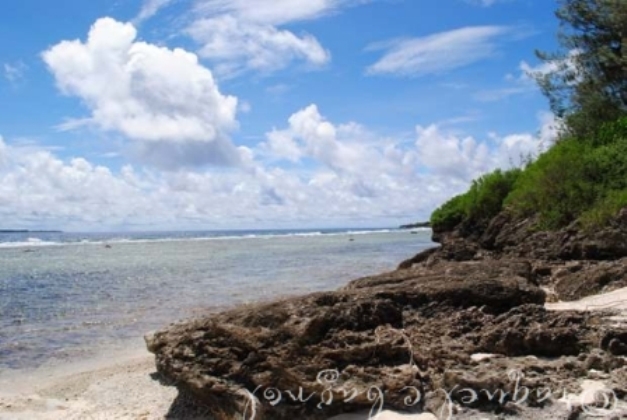
THE short, rocky pathway that we were following one afternoon a couple of weeks back that was almost hidden by overgrown bushes at the far end of the green golf courses at the Coral Ocean Point resort in Koblerville ended in a small clearing, and the sight of clear blue skies and the vast sea greeted us.
The sea glittered under the hot afternoon sun as I and two buddies surveyed the long stretch of rocky beach. It was my first time to set foot in this beach that I always see from up above every time the plane from Tinian approaches the Saipan airstrip.
The beach was deserted and silent, save for the occasional drone of the planes flying in.
Coral Ocean Point beach is one of those less frequented beaches in the island. The beach can be accessed by passing through the golf courses and we had to borrow two golf carts and walk the short distance to the beach. The beach with its sharp corals and rocky water beds is not that ideal for children and families but on the other hand, adults may find the beach as a romantic getaway, a change from the regular soft, sandy beaches in the other parts of the island.
One good thing about the Coral Ocean Point beach especially for photographers and photo enthusiasts is that there is so much to capture on lens like the beautiful corals and rocks, small cliffs, spectacular cloud formations, the clear blue waters gently slapping on the shores near the beach or the huge waves crashing on the rocky ledges from the distance.
We saw the remains of a barbeque party at a pit near the rocks and knew that some picnickers had taken advantage of the beautiful beach.
A few meters from where we were, a swimmer braved the heat and went snorkeling around. Snapping a few photos, we packed up to leave the area. I wished we had the luxury of time during that brief visit but we had other appointments and that trek to the beach was actually a side trip, not in our original plan. I would have wanted to stay longer.
If you happen to spend some time at the Coral Ocean Point beach, don’t forget to bring a camera.

Monday, October 3, 2011

A few minutes at a deserted runway

The early morning air was still and silent and we coasted along the rough roads going to one of the island’s historic landmarks some weeks back. The day has just begun as we headed for one of the long deserted airstrips at the northernmost part of the island.
Photos by Raquel C. BagnolRubbing my sleep-deprived eyes and trying to fight off a wave of drowsiness, I fished out my camera from my sling bag and started clicking away, capturing landscape and views.
I’ve been to the North Field of Tinian several times before, but it was different this time because first, it was very early in the morning (which means practically midnight for a nocturnal being like me), and second, I was with a professional photographer who knew the place and had a deeper understanding about history than what our lenses could capture.
The sun was slowly making its way up the horizon when we glided smoothly into the Runway A (Able) as my companion Dirk Spennemann started capturing the neglected airstrip with his cameras from all angles. He was collecting photos for an upcoming exhibit about places  that played roles in World War II battles all over the Pacific.
The lonely airstrip constructed of crushed coral and asphalt stretched emptily before us, with weeds and bushes growing in several parts a silent testimony to its state of neglect.
I stood still for a few moments, closing my eyes against the glare of the sun and trying to imagine what the place looked like 66 years ago.
Runway Able was just one of the six airstrips the Seabees and Marines constructed in 1945. They named the four airstrips at the North Field ABCD for Able, Baker, Charlie and Dog. Runway Able is the extra-long runway which was used for the B-29 bomber Enola Gay that dropped the atomic bomb on Hiroshima.
We didn’t go to the three other runways anymore as Dirk had more places on his list to check out and photograph. We drove out of the Runway Able and proceeded to another historical place nearby — the bomb pits where Japanese soldiers used to store their bombs and fuel.
Those few minutes we spent at Runway Able gave me a new perspective about a place many people on island may have taken for granted. It played a big role in  World War II.
A few minutes at a deserted runway | around-the-island.

Friday, September 9, 2011

Inside a World War II-era blockhouse


DRIVING on the rough path along the lush golf courses of Coral Ocean Point one day last week, I had no idea that one of the island’s historical treasures lies along the coastal area beyond the thick shrubbery that made the road almost impossible to see.
Riding in two golf cars, I and two officemates parked along the side of the path and followed a trail some meters down to the beach and I saw one of those Japanese pillboxes almost obscured by the tall weeds.
The structure, which turned out to be one of the three Japanese blockhouses constructed on island, stood as strong and proud as ever like it was constructed just recently. The blockhouse was perched in a location that provided a commanding view of the beach.
It usually takes a lot to convince me to go inside any of these old structures like bunkers but unexpectedly, an inner battle was taking place as I fought my fear of enclosed spaces and tried to curb my curiosity as I made the few steps down to the door of the structure.
Finally, my curiosity won and for the first time, I stepped inside a Japanese bunker. Ducking to avoid the spider’s web along the way, I took tentative steps inside. Contrary to what I thought, it was well lighted inside, with the rays of the afternoon sun streaming through the small rectangular windows on each of the internal partitions.
Although the walls of the blockhouse were over one yard thick and the ceiling was low, I forgot my being claustrophobic  for a moment as I stood still and surveyed my surroundings for a few minutes, trying to imagine that almost 70 years ago this place housed canons and the walls were the only mute witnesses to the bullets ricocheting from the enemy’s firing line.
The sting of mosquitoes on my arms and face brought me back to the present and I hurried out from the confines of the thick walls and into the fresh and salty air outside.
According to the interpretive sign posted by the CNMI Historic Preservation Office and the U.S. National Park Service, the 20mm blockhouse, which is also referred to as the German blockhouse, was of Japanese design and construction. The other two are at Obyan Beach and Laolao Beach. The site was placed on the National Register of Historic Places in 1995.
Inside a World War II-era blockhouse | around-the-island.

Sunday, September 4, 2011

Inside a burned out fuel bunker


MY conviction that I had explored and written short pieces about every nook and cranny that Tinian had to offer was proven wrong a few weeks back when I went on a photography jaunt with Australian professor and photographer Dirk Spennemann.
After taking photos of the Atomic Bomb Pits, airstrip and the Air Communications building, Spennemann parked our rented car in a grassy portion at the roadside a few meters away from and hauled his giant camera from the backseat. Although I had driven around several times in that area before, the place we were heading to was unfamiliar. Asking no questions, I followed him, pausing now and then to take photos of things that caught my interest.
We hiked through a tree-lined path cut into a coral hill for a few minutes before I saw where we were heading for. A massive concrete building dug into the bedrock and protected with heavy steel plate doors was at the end of the trail, sharp pieces of steel sticking out of its thick concrete roof and walls. The building, although obviously sturdily built, was broken and shattered.
We went just inside the door of the structure. I couldn’t see a thing and Spennemann told me to wait until my eyes get adjusted to the darkness. Very soon, objects like drums and huge pillars began to take shape. I trained my camera at half-shutter in different directions for some seconds before pressing it and looked at the viewfinder. I saw hundreds of burned out drums and pieces of steel inside the bunker, all in disarray at the floor. After taking a few more photos, my being a claustrophobic started to take over and I found it hard to breath. With no exit, it was humid inside. I groped my way outside, thankful for the breath of fresh air when I emerged from the structure.
A marker at the side of the building tells the story that one of the fuel storage structures was ignited sometime during the first days of American invasion and the fire got so intense that Marine battalions nearby were prompted to move to a different position. Because of the heat, huge concrete slabs stripped from the ceiling and in exploded fuel drums.
Picking our way slowly to avoid the slippery and muddy patches on the road, we went around to the other side of the canyon and saw the cement slabs that were the remaining pieces of the fuel drum storage. The Japanese bomb storage and fuel drum storage are among the most remarkable Japanese military structures on Tinian.
We left the place with more gigabytes of photos in our memory cards and an additional piece of history on a relic on Tinian that played a big role during the World War II. If you think that one day is enough to visit Tinian and explore its cultural and historical wealth, you can think again. The island has so much to offer.
Exploring a burned out fuel bunker | around-the-island.