Friday, October 7, 2011

Noonday respite at a coral beachside


THE short, rocky pathway that we were following one afternoon a couple of weeks back that was almost hidden by overgrown bushes at the far end of the green golf courses at the Coral Ocean Point resort in Koblerville ended in a small clearing, and the sight of clear blue skies and the vast sea greeted us.
The sea glittered under the hot afternoon sun as I and two buddies surveyed the long stretch of rocky beach. It was my first time to set foot in this beach that I always see from up above every time the plane from Tinian approaches the Saipan airstrip.
The beach was deserted and silent, save for the occasional drone of the planes flying in.
Coral Ocean Point beach is one of those less frequented beaches in the island. The beach can be accessed by passing through the golf courses and we had to borrow two golf carts and walk the short distance to the beach. The beach with its sharp corals and rocky water beds is not that ideal for children and families but on the other hand, adults may find the beach as a romantic getaway, a change from the regular soft, sandy beaches in the other parts of the island.
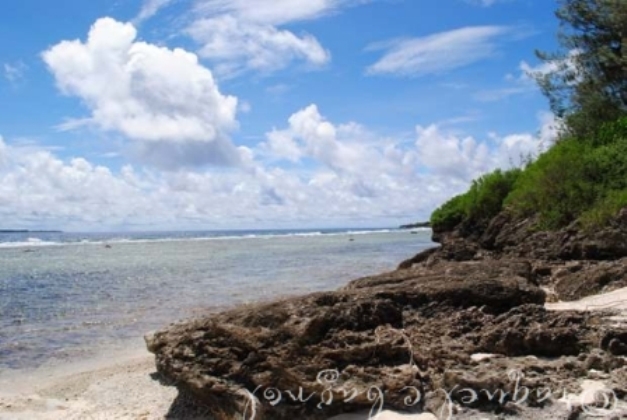
One good thing about the Coral Ocean Point beach especially for photographers and photo enthusiasts is that there is so much to capture on lens like the beautiful corals and rocks, small cliffs, spectacular cloud formations, the clear blue waters gently slapping on the shores near the beach or the huge waves crashing on the rocky ledges from the distance.
We saw the remains of a barbeque party at a pit near the rocks and knew that some picnickers had taken advantage of the beautiful beach.
A few meters from where we were, a swimmer braved the heat and went snorkeling around. Snapping a few photos, we packed up to leave the area. I wished we had the luxury of time during that brief visit but we had other appointments and that trek to the beach was actually a side trip, not in our original plan. I would have wanted to stay longer.
If you happen to spend some time at the Coral Ocean Point beach, don’t forget to bring a camera.

Monday, October 3, 2011

A few minutes at a deserted runway

The early morning air was still and silent and we coasted along the rough roads going to one of the island’s historic landmarks some weeks back. The day has just begun as we headed for one of the long deserted airstrips at the northernmost part of the island.
Photos by Raquel C. BagnolRubbing my sleep-deprived eyes and trying to fight off a wave of drowsiness, I fished out my camera from my sling bag and started clicking away, capturing landscape and views.
I’ve been to the North Field of Tinian several times before, but it was different this time because first, it was very early in the morning (which means practically midnight for a nocturnal being like me), and second, I was with a professional photographer who knew the place and had a deeper understanding about history than what our lenses could capture.
The sun was slowly making its way up the horizon when we glided smoothly into the Runway A (Able) as my companion Dirk Spennemann started capturing the neglected airstrip with his cameras from all angles. He was collecting photos for an upcoming exhibit about places  that played roles in World War II battles all over the Pacific.
The lonely airstrip constructed of crushed coral and asphalt stretched emptily before us, with weeds and bushes growing in several parts a silent testimony to its state of neglect.
I stood still for a few moments, closing my eyes against the glare of the sun and trying to imagine what the place looked like 66 years ago.
Runway Able was just one of the six airstrips the Seabees and Marines constructed in 1945. They named the four airstrips at the North Field ABCD for Able, Baker, Charlie and Dog. Runway Able is the extra-long runway which was used for the B-29 bomber Enola Gay that dropped the atomic bomb on Hiroshima.
We didn’t go to the three other runways anymore as Dirk had more places on his list to check out and photograph. We drove out of the Runway Able and proceeded to another historical place nearby — the bomb pits where Japanese soldiers used to store their bombs and fuel.
Those few minutes we spent at Runway Able gave me a new perspective about a place many people on island may have taken for granted. It played a big role in  World War II.
A few minutes at a deserted runway | around-the-island.

Friday, September 9, 2011

Inside a World War II-era blockhouse


DRIVING on the rough path along the lush golf courses of Coral Ocean Point one day last week, I had no idea that one of the island’s historical treasures lies along the coastal area beyond the thick shrubbery that made the road almost impossible to see.
Riding in two golf cars, I and two officemates parked along the side of the path and followed a trail some meters down to the beach and I saw one of those Japanese pillboxes almost obscured by the tall weeds.
The structure, which turned out to be one of the three Japanese blockhouses constructed on island, stood as strong and proud as ever like it was constructed just recently. The blockhouse was perched in a location that provided a commanding view of the beach.
It usually takes a lot to convince me to go inside any of these old structures like bunkers but unexpectedly, an inner battle was taking place as I fought my fear of enclosed spaces and tried to curb my curiosity as I made the few steps down to the door of the structure.
Finally, my curiosity won and for the first time, I stepped inside a Japanese bunker. Ducking to avoid the spider’s web along the way, I took tentative steps inside. Contrary to what I thought, it was well lighted inside, with the rays of the afternoon sun streaming through the small rectangular windows on each of the internal partitions.
Although the walls of the blockhouse were over one yard thick and the ceiling was low, I forgot my being claustrophobic  for a moment as I stood still and surveyed my surroundings for a few minutes, trying to imagine that almost 70 years ago this place housed canons and the walls were the only mute witnesses to the bullets ricocheting from the enemy’s firing line.
The sting of mosquitoes on my arms and face brought me back to the present and I hurried out from the confines of the thick walls and into the fresh and salty air outside.
According to the interpretive sign posted by the CNMI Historic Preservation Office and the U.S. National Park Service, the 20mm blockhouse, which is also referred to as the German blockhouse, was of Japanese design and construction. The other two are at Obyan Beach and Laolao Beach. The site was placed on the National Register of Historic Places in 1995.
Inside a World War II-era blockhouse | around-the-island.

Sunday, September 4, 2011

Inside a burned out fuel bunker


MY conviction that I had explored and written short pieces about every nook and cranny that Tinian had to offer was proven wrong a few weeks back when I went on a photography jaunt with Australian professor and photographer Dirk Spennemann.
After taking photos of the Atomic Bomb Pits, airstrip and the Air Communications building, Spennemann parked our rented car in a grassy portion at the roadside a few meters away from and hauled his giant camera from the backseat. Although I had driven around several times in that area before, the place we were heading to was unfamiliar. Asking no questions, I followed him, pausing now and then to take photos of things that caught my interest.
We hiked through a tree-lined path cut into a coral hill for a few minutes before I saw where we were heading for. A massive concrete building dug into the bedrock and protected with heavy steel plate doors was at the end of the trail, sharp pieces of steel sticking out of its thick concrete roof and walls. The building, although obviously sturdily built, was broken and shattered.
We went just inside the door of the structure. I couldn’t see a thing and Spennemann told me to wait until my eyes get adjusted to the darkness. Very soon, objects like drums and huge pillars began to take shape. I trained my camera at half-shutter in different directions for some seconds before pressing it and looked at the viewfinder. I saw hundreds of burned out drums and pieces of steel inside the bunker, all in disarray at the floor. After taking a few more photos, my being a claustrophobic started to take over and I found it hard to breath. With no exit, it was humid inside. I groped my way outside, thankful for the breath of fresh air when I emerged from the structure.
A marker at the side of the building tells the story that one of the fuel storage structures was ignited sometime during the first days of American invasion and the fire got so intense that Marine battalions nearby were prompted to move to a different position. Because of the heat, huge concrete slabs stripped from the ceiling and in exploded fuel drums.
Picking our way slowly to avoid the slippery and muddy patches on the road, we went around to the other side of the canyon and saw the cement slabs that were the remaining pieces of the fuel drum storage. The Japanese bomb storage and fuel drum storage are among the most remarkable Japanese military structures on Tinian.
We left the place with more gigabytes of photos in our memory cards and an additional piece of history on a relic on Tinian that played a big role during the World War II. If you think that one day is enough to visit Tinian and explore its cultural and historical wealth, you can think again. The island has so much to offer.
Exploring a burned out fuel bunker | around-the-island.

Friday, August 26, 2011

An afternoon at the Tinian Shrine

 I’ve seen the sign on the fork of the road lots of times before, a crudely made piece of wood painted with the words “Tinian Shrine” with an arrow pointing to a rough road leading to a thick shrubbery.
Photos by Raquel C. BagnolThe huge potholes in the road are a big turnoff especially if you are not driving a four-wheel drive or if you are not that adventurous. I had been out exploring and photographing the historical sites of Tinian with visiting photographer and professor Dirk Spennemann from Australia one day a couple of weeks back and the Tinian Shrine was not in our itinerary.
But then, we had an unspoken agreement to “follow the roads and no questions asked until we get there” so off we went.
Spennemann drove all the up to the top of the Carolinas Heights Subdivision, deftly avoiding the huge potholes and the soft portions on the road leading up and stopped at a dead end. Or so we thought when we saw another crudely built sign with an arrow pointing to oh, miracles — a single lane dirt road almost obscured by the thick shrubbery. Hesitant to drive further, my companion said we’d have to walk the rest of the way up.
I was not interested to walk because I was getting tired and my brain was attempting to shut off any minute after working at the computer for the whole night, added to the heat of the 3 p.m. sun blazing down on us and we didn’t even have a drop of water to quench our thirst, my flimsy sandals already gave out from our earlier trek to the North Field that morning so that I had to tie the straps to my toenails, all this added to our heavy cameras and bags.
Visiting photographer and professor of Charles Stuart University Dirk Spennemann aims for a horizontal shoot with his improvised camera.Spennemann finally gave in and taking on a “whatever” stance, took the wheel again. Luckily, the road widened when we were already some meters deep into the bushes and we drove on and up until we reached our destination.
There, nestled amid more shrubbery and green foliage is a wide torii gate and a long flight of slippery, moss-covered stone steps leading up to a stone-built inner shrine at the top. The shrine was deserted so we had the place to ourselves.
Unpacking our gear, we started working and forgot everything else. For the next hour or so, only the clicking of the shutters broke the deafening silence, save for the occasional chirping of birds and crickets.
Although we were just about a couple of miles away from the center of Tinian, I couldn’t shake off the uneasy feeling that we were in another world and were being observed by unseen beings.
I stood still for a few seconds when I reached the small cement house at the top, shrugging off my uneasiness as I glared back at the pair of glaring stone dragons that acted as guards at the entrance of the inner shrine. I learned that the small house was already renovated and renovated after termites the original wood and copper roof.
It was not hard to imagine how Japanese people left offerings in this abandoned Japanese shrine with. An air of solemnity ruled the place and you get the feeling of being intruders and it felt like a sacrilege to touch anything or to even make a slight noise to break the silence.
The small Shinto shrines at the side of the long stairway showed signs of neglect, with several of its smaller stone monuments left shattered around.
The Sumiyoshi Shinto Shrine or popularly known as the Tinian Shrine is one spot that you should not miss on any visit to this island.
An afternoon at the Tinian Shrine | around-the-island.

Friday, August 19, 2011

Revisiting a WW2 structure


A few meters away from the air raid shelters and the monuments erected in memory of the marine battalions is the dilapidated yet sturdy structure used to house the air administrations staff building in the North Field of Tinian. Except for the distant whirring sounds of a brush cutter some maintenance men making as they cleaned the area, everything else was quite and deserted. It was just half past 7 a.m. and we have the place to ourselves.
Add caption
I’ve been to the same building a couple of times in the past three years but those were just for a quick stop to take quick photos, and off to other, more interesting sites in the island.
Last week was different. I flew in to Tinian real early with Dr. Dirk Spennemann, a visiting professor from the Charles Sturt University in Australia to visit the historical places and take photos of the people and life in the island.
What made that trip totally different from my previous trips was that I was with somebody who is not only a professional photographer but one trained to see more than what we ‘ordinary mortals’ see, and one who was willing to share his knowledge.
We spent some time in the kitchen area and Spennemann pointed out where the sink and cooking pots used to be installed, the areas where the washrooms and restrooms were, and gave special attention to how the walls, floor tiles and ceilings were designed.
I paid just a passing glance to a white cloth with Japanese symbols and a glass of water placed on the sink. Alongside it were three pieces of incense sticks. To my untrained eye, those were just objects left by some tourists but Spennemann took his time taking photos of it. Only then did I understand that those objects were purposely left by Japanese individuals as offering to their relatives who have passed on during the war.
We gingerly picked our way through the debris and up the slippery stairs to the second floor, where more traces of devastation awaited us. One can just imagine what a busy office that place used to be.
Spennemann pointed out the concrete walls, floors and pillars, the thick pieces of steel sticking out from what was left of the concrete after bombs ripped through. Honestly, I saw the concrete walls, floors and pillars and the thick steel pieces and nothing more as leftovers of a sturdy building before but never took any notice of how sturdily built the building really was so that it is still standing after several decades and despite having several of its pillars blown off by the bombs.
Spennemann said that the constructors did a commendable job using materials designed to last for decades.
Where before I just saw the ruins of the air administration building as one of the must-visit historical sites on Tinian, I left that building not only with hundreds of photos in my camera but saw it under a different light, not only as a remnant of the bloody war but of the important role it played.
Records show that the air administration staff building used to be the headquarters for the Japanese Navy’s 1st Air Fleet under the command of Vice Admiral Kakuji Kakuta, and the building was just one of those vital structures that played an important role in the final stage of the war of the Pacific.

Friday, August 5, 2011

Stopover at Teteto Beach


ROTA—Driving along the paved road from Songsong going to Sinapalo Village on Rota will give you a chance to enjoy many scenic spots that may hinder your trip if you are in a hurry, and this includes pristine beaches, lush jungles, historical sites, and more attractions packed into this small paradise of an island.
One of the island’s attractions that you should and could not miss is this long stretch of a usually deserted white, sandy beach called Teteto Beach Club, located about three and a half miles away from the Rota International Airport. I mean deserted in the sense that you will feel you have rented the whole beach for yourself when you go there. It could be because the island’s limited population just takes the beach for granted, and tourists have other activities and places to explore there, except for few minutes’ stopover.
The slight drizzle did not hamper me from stopping by one afternoon some months back to snap some photos. Contrary to what any photographer would have wanted to capture, there was no blue clouds and bright sun shining above. Instead, the weather was bleak and huge, angry waves crash
Nobody was around, and I felt a little bit strange and apprehensive as I parked my rented car a few feet away from the sign board advertising the name of the beach but I decided to be brave and went out. The umbrellas used to shelter loungers were folded as nobody was using them, and I guess as a protection from being blown by the strong winds. I took quick snapshots as I tried to fight off the uncanny feeling that I was not alone and that someone or something was observing me. Scolding myself for entertaining such thoughts in broad daylight, I hurried back to the car and drove on.
On a bright sunny day, the Teteto Beach would have been a perfect spot to relax and unwind, stretch and read your favorite book, or sunbathe on the loungers.
The water at Teteto Beach looks shallow and safe, but I was told the current could be sometimes pretty strong.
Teteto Beach with its pristine shores is ideal for family picnics, for beach activities, for hanging out or for simply communing with nature.
I would have loved to capture one of the stunning sunsets over Teteto Beach from photos I’ve seen online posted by several photographers but my timing was not good because the weather was not cooperative, and I had to hurry to catch my flight back to Saipan. Maybe, next time.